One of the most common questions we receive at Ohana Martial Arts Academy is: "What is the difference between Kenpo Karate and Jiujitsu?" With the enormous popularity of Brazilian Jiujitsu (BJJ) in mixed martial arts and mainstream culture, many families assume that all jiujitsu is the same. In reality, there are significant differences between these arts — and understanding them can help you make an informed choice about your family's martial arts training.
What Is International Kenpo Karate?
International Kenpo Karate is a modern, practical martial art that emphasizes efficient self-defense through a comprehensive system of strikes, blocks, kicks, and movement patterns. Rooted in Chinese and Japanese martial arts traditions but refined for modern application, Kenpo is often called the "thinking person's martial art" because of its emphasis on understanding why techniques work, not just how to perform them.
Kenpo practitioners learn to respond to a wide range of attacks using principles of motion, angle, and body mechanics. Rather than memorizing a fixed response to every possible attack, students develop an understanding of martial arts concepts that allow them to adapt and respond fluidly to real-world situations.
Key characteristics of International Kenpo include:
- Stand-up self-defense: Primary focus on defending against attacks while standing, including strikes, grabs, pushes, and weapon threats
- Rapid-fire techniques: Kenpo is known for its fast, multiple-strike combinations that overwhelm an attacker
- Practical application: Techniques are designed for real-world scenarios, not sport competition
- Forms (katas): Choreographed sequences that teach movement principles, body mechanics, and martial arts concepts
- Progressive curriculum: A structured belt system that builds skills systematically from basic to advanced
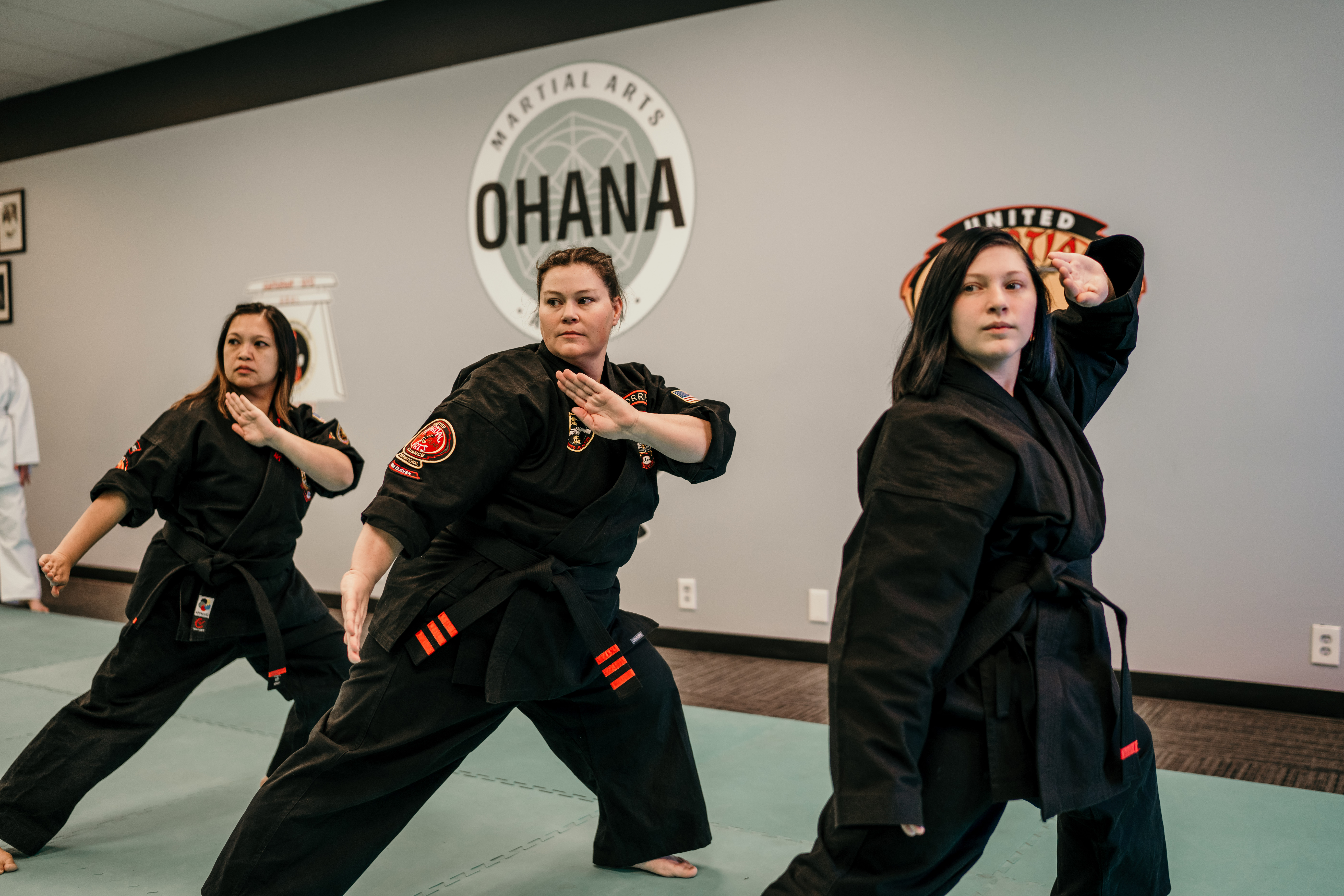
At Ohana, Kenpo forms the core of our curriculum across all age groups. Our Chief Instructor, Sensei Carissa Morris, holds a 5th Degree Black Belt in International Kenpo and has been studying the art for over 18 years. The structured, principle-based nature of Kenpo makes it an excellent system for children and adults alike, as students can begin applying concepts from their very first class.
What Is Brazilian Jiujitsu (BJJ)?
Brazilian Jiujitsu is a grappling-focused martial art that emphasizes ground fighting and submission techniques. Developed in Brazil from Japanese Judo and traditional Jiujitsu, BJJ gained worldwide fame through the early Ultimate Fighting Championship (UFC) events, where smaller BJJ practitioners demonstrated that technique and leverage could overcome larger, stronger opponents.
BJJ is primarily a sport-oriented martial art, with a highly developed competition circuit and ruleset. Training focuses heavily on:
- Ground grappling: Taking the fight to the ground and controlling an opponent through positioning
- Submissions: Joint locks and chokes designed to force an opponent to submit (tap out)
- Guard positions: Fighting effectively from the bottom position, including sweeps and submissions
- Sport competition: Training is often oriented toward tournament success under specific rulesets
- Rolling (sparring): Live grappling sessions are a central part of training from early stages
BJJ has become enormously popular and has produced many excellent martial artists. It is a legitimate and effective martial art, particularly in the context of one-on-one sport competition.
Traditional Japanese Jiujitsu: The Original Art
At Ohana, we teach Kamishin Ryu Jiujitsu — a traditional Japanese Jiujitsu system — not Brazilian Jiujitsu. This distinction is important because the two arts, despite sharing a name, have different philosophies, techniques, and training approaches.
Traditional Japanese Jiujitsu (sometimes spelled Jujitsu or Jujutsu) is the parent art from which both Judo and Brazilian Jiujitsu were derived. It was originally developed by Japanese samurai as a method of defeating armed and armored opponents in close combat. As a result, traditional Jiujitsu includes a much broader range of techniques than BJJ:
- Throws and takedowns: Getting an opponent to the ground using leverage, balance disruption, and body mechanics
- Joint locks: Controlling or subduing an opponent through manipulation of joints and limbs
- Strikes and kicks: Unlike BJJ, traditional Jiujitsu includes striking as part of its technical repertoire
- Weapon defenses: Techniques for defending against common weapons, reflecting the art's samurai origins
- Standing self-defense: Emphasis on practical scenarios that begin and may resolve while standing
- Multiple attacker awareness: Recognition that real self-defense situations may involve more than one threat
Sensei Neil Morris holds a 5th Degree Black Belt in Kamishin Ryu Jiujitsu and brings over 35 years of martial arts experience to our Jiujitsu program. The Kamishin Ryu system is particularly well-suited to complement Kenpo Karate, as both arts share principles of efficient movement, practical application, and progressive skill development.
Key Differences at a Glance
| Aspect | International Kenpo | Brazilian Jiujitsu | Kamishin Ryu Jiujitsu |
|---|---|---|---|
| Primary Focus | Stand-up self-defense | Ground grappling | Complete self-defense |
| Range | Striking range | Ground and clinch | All ranges |
| Orientation | Self-defense | Sport competition | Self-defense |
| Techniques | Strikes, blocks, kicks | Submissions, sweeps | Throws, locks, strikes |
| Multiple Attackers | Addressed | Not typically addressed | Addressed |
| Weapon Defense | Included | Not typically included | Core component |
| Philosophy | Practical efficiency | Positional control | Traditional warrior arts |
Why We Teach Both Kenpo and Traditional Jiujitsu
The combination of International Kenpo Karate and Kamishin Ryu Jiujitsu creates a comprehensive martial arts education that prepares students for a full range of self-defense situations. Kenpo provides excellent stand-up skills — the ability to defend against attacks while on your feet, where most real-world encounters begin. Kamishin Ryu Jiujitsu adds the ability to control a situation if it goes to the ground, defend against grabs and holds, and execute throws and takedowns safely.
This combination also reflects our philosophy that martial arts training should be about practical self-defense and personal development, not sport competition. While we respect the athletic achievements of sport martial arts, our primary concern is that our students — many of whom are children — develop skills that will keep them safe in real-world situations.
Real self-defense situations do not follow competition rules. They may involve multiple attackers, weapons, uneven terrain, or the need to protect someone else. By training in both Kenpo and traditional Jiujitsu, our students develop the versatility and awareness to handle these unpredictable scenarios.
Our Kamishin Ryu Jiujitsu Program
Ohana offers dedicated Kamishin Ryu Jiujitsu classes on Friday evenings, open to students ages 12 and up who have a foundation in our Kenpo curriculum. These classes allow students to deepen their martial arts education with specialized training in throws, joint locks, ground defense, and traditional Jiujitsu techniques.
The Friday Jiujitsu classes are included in our standard membership at no additional cost. This means that students who want a well-rounded martial arts education can train in both Kenpo and Jiujitsu without paying for separate programs — a significant value compared to schools that charge separately for different styles.
Choosing the Right Martial Art for Your Family
Both Kenpo and Jiujitsu (in any form) are excellent martial arts with much to offer. The right choice depends on your family's goals:
- If you want practical self-defense that covers standing and ground situations, Kenpo plus traditional Jiujitsu is an excellent combination
- If your child is interested in grappling sport competition, BJJ may be a good fit
- If you value character development alongside physical training, a traditional school with a structured curriculum (like Ohana) provides both
- If you want your child to develop striking and defensive skills first, Kenpo provides a strong foundation that can be supplemented with grappling later
We welcome you to visit Ohana for a free trial class and see how our integrated approach to Kenpo and traditional Jiujitsu provides a complete martial arts education for students of all ages.
Sensei Neil Morris
Instructor, 5th Degree Black Belt in Kamishin Ryu Jiujitsu
Ohana Martial Arts Academy in Firestone, Colorado. Dedicated to helping children and families in Carbon Valley build confidence, discipline, and character through expert martial arts instruction.
Know a parent who would find this helpful? Share it with them.
Stay in the Loop
Get martial arts tips, academy updates, and exclusive offers delivered to your inbox. Join the Ohana community today.